
Best Football Formations with 10 Players: How Teams Adapt After a Red Card
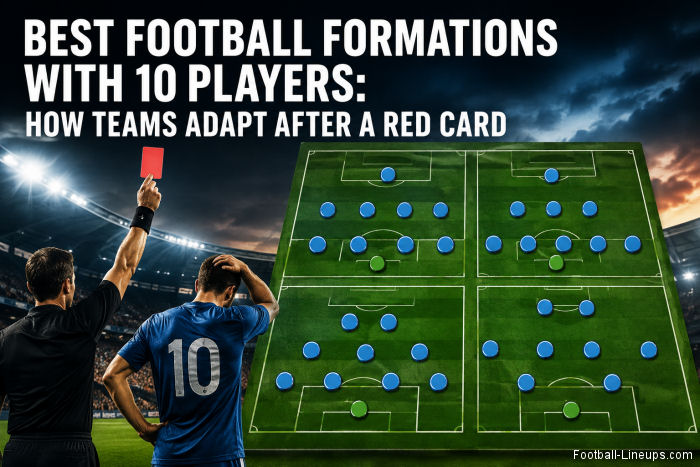
A 4-4-1 is often the safest football formation for a team playing with 10 players. It protects the center and both flanks, creates two compact defensive lines, and keeps one forward available for counterattacks. However, a team protecting a late lead may prefer a 5-3-1, while a side that must score can take more risk with a 4-3-2 or 3-4-2.
Under the Laws of the Game, a player sent off after kickoff cannot be replaced. The coach must reorganize nine outfield players around a goalkeeper. The right solution depends on who received the red card, the score, the opponent’s shape, and the time remaining.
What Is the Best Formation for Playing with 10 Men?
The best formation with 10 players closes dangerous spaces without removing every attacking option. In most situations, 4-4-1 is the practical default.
Formation numbers exclude the goalkeeper. A 4-4-1 therefore means four defenders, four midfielders, and one forward, plus the goalkeeper.
| Formation | Best Used When | Main Strength | Main Risk |
|---|---|---|---|
| 4-4-1 | Protecting a draw or narrow lead | Balanced coverage | Isolated striker |
| 5-3-1 | Defending under heavy pressure | Strong box protection | Team may drop too deep |
| 4-3-2 | A goal is still needed | Two counterattacking outlets | Limited width |
| 3-4-2 | Chasing the game late | More attacking support | Space behind midfield |
A red card should change responsibilities before it changes the team’s entire identity. The best shape is one the players can recognize and maintain under pressure.
What Determines the Formation After a Red Card?
The first question is not “Which formation is best?” It is “Which role has just been lost?”
If a striker is sent off, the defensive structure may remain largely intact. If a center back leaves, the coach may need to remove an attacker and introduce a defender. Losing a central midfielder exposes the area in front of the defense, while losing a fullback creates an immediate problem on one side.
The score and clock matter just as much. A team leading with eight minutes left can defend more conservatively than one reduced to 10 in the first half. UEFA’s recent analysis of red-card situations also stresses the importance of match state and remaining time.
These changes alter pressing, possession, counterattacking space, and in-play expectations. That is why lineup information is watched by analysts, sportsbooks, and online casino sites https://www.pokerlistings.com/casino-sites with sports-betting sections. The useful signal is not simply the red card, but how the coach reorganizes the team afterward.
The Best Football Formations with 10 Players
The most effective formations for playing with 10 men are 4-4-1, 5-3-1, 4-3-2, and 3-4-2. Each shape solves a different tactical problem: 4-4-1 provides balance, 5-3-1 strengthens deep defense, 4-3-2 preserves a counterattacking threat, and 3-4-2 adds attacking support when a team must score. The right choice depends on the score, the time remaining, the opponent’s approach, and the position of the player who was sent off.
4-4-1: The Most Balanced 10-Man Formation
A 4-4-1 is the best starting point when the team needs stability. Two banks of four protect central areas while allowing the wide midfielders to support the fullbacks.
The midfield must stay narrow enough to block passes through the center without surrendering the wings. When the ball moves wide, the nearest midfielder presses, the fullback covers, and the rest of the unit shifts across.
The lone striker should not waste energy chasing both center backs. The forward can block passes into the holding midfielder, guide possession to one side, and provide a target after the ball is recovered.
The main weakness is isolation. If all four midfielders remain too deep, every clearance comes straight back. One wide midfielder should support the striker whenever the team can counter.
5-3-1: The Best Formation for Protecting a Lead
A 5-3-1 works when the opponent is creating overloads near the penalty area or delivering repeated crosses. Three center backs protect the box, the outside defenders cover width, and three midfielders screen central passes.
This shape is especially useful late in a match. In a recent UEFA Europa League example, Lyon switched to a 5-3-1 after an early red card to a center back.
The danger is becoming trapped. If the outside defenders and midfielders retreat too far, the team loses every route out. At least one midfielder must support the striker, and the defensive line should step forward when pressure on the ball allows it.
4-3-2: A More Attacking Option with 10 Men
A 4-3-2 keeps a standard back four, adds three central midfielders, and leaves two attackers higher. It suits a team that is level or behind and still needs to threaten.
The two forwards can split into the channels or take turns dropping toward midfield. Their presence also discourages both opposing fullbacks from attacking at once.
The weakness is width. The outside central midfielders must slide toward the flanks, while the fullbacks must choose their forward runs carefully. The system works best with mobile midfielders and quick attackers who can advance the ball without heavy support.
3-4-2: A High-Risk Formation for Chasing the Game
A 3-4-2 is an aggressive late-game option. Three defenders remain behind the ball, four midfielders provide width and support, and two attackers occupy advanced positions.
It creates better attacking connections than a deep 5-3-1 and allows the team to press with two players. The trade-off is defensive space. The wide midfielders must recover quickly, and the three defenders must handle direct runs.
This is a deliberate gamble, not a default response. Recent UEFA analysis has also shown that teams can keep attacking with 10 when their positioning, passing options, and tactical principles remain clear. Lyon, for example, scored twice after going down to 10 players in a 2024/25 Europa League match against Manchester United.
How Should a Team Play with 10 Men?
Changing the formation is only the first step. The team also needs clear rules for defending and attacking.
Stay Compact Without Defending Too Deep
The reduced team should protect the center and force play toward the sidelines. Short distances between defense and midfield make it harder for opponents to receive between the lines.
Compact does not mean passive. The block should move forward when the opponent plays backward, takes a poor touch, or loses control of the ball. Retreating automatically to the penalty area gives the other team time to recycle possession and attack again.
Press Selectively, Not Constantly
A team with 10 rarely has the coverage to press everywhere. Useful pressing triggers include:
- a backward pass;
- a poor first touch;
- a receiver facing their own goal;
- a pass toward an isolated fullback;
- a slow or inaccurate switch of play.
The nearest player presses while teammates close nearby options. Uncoordinated individual sprints only create new gaps for the opponent to exploit.
The lone forward should usually guide the buildup toward one side rather than chase every defender. This conserves energy and makes the direction of the press easier for teammates to anticipate.
Keep a Counterattacking Outlet
Leaving one attacker higher gives the team a target and forces the opponent to retain defensive cover. That player can win a foul, hold up the ball, carry it into space, or give teammates enough time to move out of their defensive third.
The first pass after a regain does not always need to go forward. A short, secure pass may be the best way to escape pressure. However, aimless clearances should be avoided when a controlled outlet is available.
UEFA’s analysis of ten-man Ajax highlighted how coordinated individual defending helped the team protect its aggregate advantage after an early red card. The broader lesson is that playing with 10 should not become 30 or 60 minutes of uncontrolled emergency defending.
How the Formation Changes Based on the Red-Carded Player
The position of the dismissed player usually determines the first adjustment.
| Player Sent Off | Typical Response | Likely Formation |
|---|---|---|
| Striker | Keep the defensive unit and leave one attacker up front | 4-4-1 |
| Winger | Narrow the midfield or drop the opposite winger | 4-4-1 or 4-3-2 |
| Central midfielder | Remove an attacker to restore central coverage | 4-4-1 or 5-3-1 |
| Fullback | Move a winger back or introduce a defender | 4-4-1 |
| Center back | Replace an attacker or form a back three | 4-4-1, 5-3-1, or 3-4-2 |
| Goalkeeper | Introduce a substitute goalkeeper and remove an outfield player | Depends on the score |
A substitution does not always need to happen immediately. If the remaining players can cover the vacant role, the coach may first assess how the opponent responds.
For example, a winger may be able to drop into the fullback position temporarily. A defensive midfielder may also move into the back line until the next stoppage. Making an instant substitution without evaluating the new match situation could remove an attacking option the team will need later.
A goalkeeper red card is different because the team must have a goalkeeper before play restarts. The coach can introduce a substitute goalkeeper, provided a substitution is available, or assign one of the remaining players to the position.
Which 10-Man Formation Should a Team Choose?
Choose a 4-4-1 for the safest balance between defensive coverage and counterattacking potential. Use a 5-3-1 to protect the penalty area and defend a late lead. A 4-3-2 preserves two advanced outlets, while a 3-4-2 offers a higher-risk solution when the team must chase a goal.
The best formation with 10 players is not always the most defensive one. It is the shape that protects essential spaces, suits the available players, and still provides a realistic way to move the ball away from goal.