
Bundesliga Matchday Preview: Key Lineups, Form Guide and Likely Outcomes
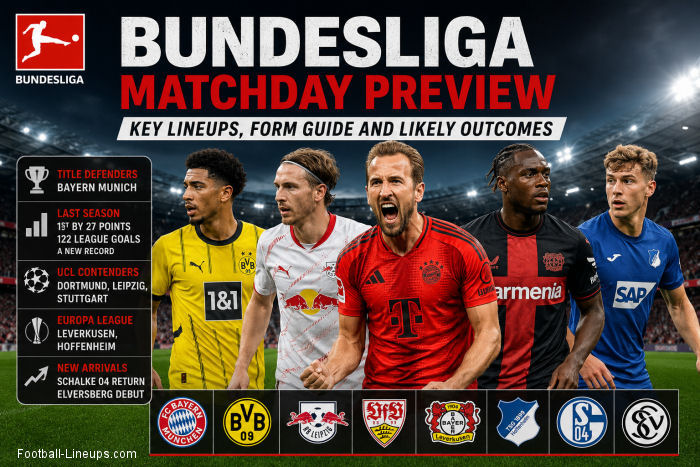
Bayern Munich enter the 2026/27 season as defending champions when the new Bundesliga campaign begins on 28 August, following a record-breaking season in which they finished 27 points clear at the top and scored 122 league goals, the highest total recorded in a modern-era season among Europe's top five leagues. On paper, though, the title race looks to be competitive: Borussia Dortmund, RB Leipzig and VfB Stuttgart begin the new season in the Champions League, while Bayer Leverkusen and Hoffenheim venture into Europa League football. New arrivals include Schalke 04 who return to the club after three years out and SV Elversberg making their Bundesliga debut.
Any Bundesliga title prediction for the new season begins with a simple question: can anyone close the 27-point gap to Bayern Munich? As always, the answer is less about squad budgets than about what happens matchday to matchday — in other words, who is starting and what shape the team is in. Without lineup context, predicting Bundesliga matches becomes little more than guesswork. For data-driven Bundesliga betting predictions, VOdds covers every matchday — bet on Bundesliga. Build Bundesliga football match predictions 2026 around form, rotation, and tactical shape.
Why Lineups Define Bundesliga Match Outcomes
Some German clubs rotate more than others. Bayern, Dortmund, Leipzig and Leverkusen each have European commitments into 2026/27 — four in the Champions League alone — so the DFB-Pokal and a compressed schedule will make selection decisions that will have a clear bearing on performance in the league. Some clubs are better at absorbing rotation than others. Bayern under Vincent Kompany demonstrated last season that they could still field a strong XI despite rotation — with Neuer, Kimmich, Musiala and Kane remaining the backbone of the side.But clubs like RB Leipzig are far more tactically sensitive. In their pressing system under Ole Werner, they use particular forward roles to set the press running. Remove Yan Diomandé or Nusa from that setup and you have the framework change over the entire team — and not just the attack. Injury timing compounds this. If a player is ruled out two days before a match, the manager has less time to prepare for an alternative plan than they would by a longer-term absence. That difference shows itself in how organised a team looks in the first 20 minutes. Another important factor is fixture congestion. The teams that play Thursday in Europe and Saturday in the Bundesliga have a real physical deficit — one that rarely makes the headline team news, but that comes through in second-half production and pressing intensity.
Key Bundesliga Fixtures and Expected Starting XI Insights
Based on the final Matchday 34 lineups from 2025/26, recent selection trends, and current squad composition, these are the likely starting structures of the Bundesliga's leading clubs heading into the new season:Likely cores based on Matchday 34, recent selection trends, and current squad composition:
Bayern Munich — Coach: Vincent Kompany
- Expected shape: 4-2-3-1
- Neuer – Stanišić, Upamecano, Tah, Laimer – Kimmich, Goretzka – Olise, Musiala, Díaz – Kane
- Primary absentee dangers: Davies (hamstring), Gnabry (groin history), wide cover
- Selection tendency: coming into pretty close to full strength versus top-six; rotates across DFB-Pokal and European groups
- Watch: shifts in the holding midfield duo — a deeper place for Kimmich suggests Bayern are managing the game, not chasing it.
Borussia Dortmund — Coach: Niko Kovač
- Expected shape: 4-2-3-1
- Meyer – Reggiani, Anton, Schlotterbeck – Couto, Sabitzer, Bellingham, Svensson – Beier, Inácio – Silva
- Primary absentee risks: Can (knee), Bensebaini (foot) – both missed Matchday 34
- Selection tendency: more conservative away from home; presses high at the Westfalenstadion, sits deeper on the road.
- Watch: if Dortmund press from the first whistle — a passive start signals they're set up to counter, not control.
RB Leipzig — Coach: Ole Werner
- Expected shape: 3-4-2-1 or 4-3-3 pressing model
- Gulácsi – Baku, Orbán, Lukeba, Raum – Ouédraogo, Schlager, Baumgartner – Diomandé, Rômulo, Nusa
- Key absentee risks: any one of the two attacking midfielders who trigger the press — the system operates on the basis of their movement
- Selection tendency: when fit very consistent; adapts shape instead of personnel
- Watch: Diomandé's positioning — as he slips into midfield, Leipzig are pressing; as he hovers high, they're in transition mode
Bayer Leverkusen — Coach: Kasper Hjulmand
- Expected shape: 3-4-2-1
- Flekken – Quansah, Andrich, Tapsoba – Culbreath, Palacios, García, Grimaldo – Maza, Poku – Schick
- Key absentee risks: Terrier (hamstring), wing-back cover on both sides
- Selection tendency: specific positional roles that do not interchange easily; Hjulmand's philosophy of shape over personnel is noteworthy
- Watch: Grimaldo's buildup — aggressive means Leverkusen are pressing, conservative means they sit in a block
Mid-table sides and Eintracht Frankfurt
- More susceptible to XI changes than the top four
- Home form is usually far stronger than away
- Worry about losing defensive organisation if a key player misses — confirm full lineup before assessing the fixture
Form Guide – Who Is Peaking at the Right Time?
The last table from 2025/26 tells a different story. Matchday form entering the new season tells another. Bayern finished the campaign on an unprecedented streak — 122 goals in 34 matches, 3.59 per game, the second-highest average among Europe's top leagues in history. Losing was not what Kompany's side was up to; they were winning by volume. It is that kind of momentum that is transferred to pre-season training and pre-match attitude. Dortmund secured second on the last day, in dramatic fashion, sneaking into the Champions League places when the table could have gone either way. That same kind of late-season pressure — not comfort — can double the stakes in August: the squad comes sharp and driven, or they come relaxed and slower to find top gear. Leipzig's form collapsed late.Freiburg defeated them 4-0 on the final day to clinch Conference League football. Werner's side will understand that their analysts' forecasts for the German Bundesliga pointed to a title challenge that never emerged. How they respond to the disappointment in those opening matchdays is one of the more intriguing threads of the new season. Leverkusen finished sixth, well under their pre-season expectations. Hjulmand was named manager mid- season and is now in his first full pre-season period with the team. Early matchdays will be the true test of whether his system has properly ingrained. Home and away form splits are more important for Bundesliga play than for most top leagues. The atmosphere on German grounds is a true factor in pressing intensity — at home and on the road there are quite a few mid-table clubs whose numbers are drastically different. Without venue context, Bundesliga football match forecasts 2026 ignore a variable that has been somewhat more consistent in the division.
Tactical Battles That Could Decide Matchday
The Bundesliga's tactical identity is built around aggressive pressing. Most clubs press high, meaning that midfield second balls determine the tempo of the game more than in most European leagues. The team that wins these midfield duels often dictates the tempo of the match. Three battles repeated across any matchday:- Press vs. build-up. The opening 10 minutes, when a high-pressing side confronts a team skilled at playing out from the back creates a pace for the rest of the game. When the press is bypassed two or three times early, that intensity falls. If it takes the ball in dangerous spots, it ramps up and the defending team goes long. Your lineup tells you which side has the personnel to fuel it.
- Wide vs. central attacking strength. Bayern (Olise, Díaz) and Leverkusen (Grimaldo, Culbreath) help extend teams through width. Sides that play narrow lose the wide areas, and then rely on crosses into Kane or Schick. Sides that defend wide give up the central zones to Musiala or Leipzig's press runners. Neither is comfortable. You can then observe how the opposition sets its defensive shape during the first five minutes — and this tells you which problem they decided to accept as their issue.
- Tactical signals, substitutes. German managers use benches proactively. A defensive midfielder's appearance at the 60th minute for a forward is almost always something from the team that says that they are protecting a result. An early arrival suggests that they are chasing an attacker and they are doing so. Monitoring the timing of substitutions relative to the score provides a real-time indication of how each of the managers is reading the game.
Likely Outcomes Based on Lineups and Form
Some of the frameworks I have developed for reading matchday results in the lead-up to this new season are:- Tight matches and draw potential. Games with high stakes and potential for draws cluster in mid-table cases when both sides have settled squads and are matched up, but neither has an overwhelming home advantage in the specific clash. Mid-table versus mid-table in August — when fitness levels are still building — produces more draws than in the rest of the season. The form here tells us that it is in these fixtures where the confirmed lineup makes the difference; one player absent can change the pitch entirely.
- Strong home advantage cases are particularly pronounced if the home side has an already settled starting XI, the away side is rotating after a European fixture earlier in the week, and the current head-to-head record sways in favour of home. Bayern at the Allianz Arena versus sides that don't press well is the clearest manifestation of this pattern — tactical advantage meets home atmosphere to yield consistent results.
- Upset risk fixtures. Upset risk of fixtures is greater when a top-half side is coming off an extended midweek away trip, has had at least two extra days of rest, and is without a central midfielder. Leverkusen has been plagued with inconsistent results on a Bundesliga weekend away from their home ground midweek — and let's not forget when their Europa League schedule coincides with the league calendar. Use neutral language when reading these frameworks. That a tiny edge in lineup quality doesn't ensure the result. Form indicates tendencies, not certainties — and tactical advantage might fall away after a single red card or a goal early against the run of play can erase any kind of advantage.

Interview Insight – VOdds Perspective on Match Preparation
We spoke to the VOdds analysis team about how they methodologically prepare for Bundesliga matchday before anything else.- With pre-calculated lineups: "The XI is the starting point, full stop. Everything else — form data, head-to-head records, home advantage — gets passed through the filter of who is really on the pitch. Any predicted lineup is only a functioning guess. You move it around once the official announcement comes around, reassess. If a key player is missing in your line-up that you hadn't prepared for, your entire read on the fixture might be influenced."
- On tactical consistency among managers: "Kompany at Bayern and Werner at Leipzig remain surprisingly consistent in their tactical approach regardless of opponent." Hjulmand at Leverkusen is newer — his first full pre-season means the opening matchdays are likely going to tell you a lot about how deep the system actually is.
- On squad rotation and European congestion: "The managers in their first full season often display their clearest patterns in games two through five, once the opening jitters are gone. Four Bundesliga clubs in the Champions League this season means Thursday-Saturday scheduling will have an impact on lineup decisions starting in September. A team that played 90 competitive minutes midweek and then faces a top-six Bundesliga opponent on Saturday is in a genuinely difficult position, even with a clean injury report. That context rarely enters pre-match analysis but often appears in second-half performance and pressing intensity."
- A team that played 90 competitive minutes mid-week and has a top-six Bundesliga opponent to face on Saturday is in a truly challenging position, even with a clean injury report. That context rarely enters pre-match analysis but is present continually in second-half performance, and pressing intensity."
What This Means for Fans and Analysts
Good Bundesliga matchday reading relies on the correct sequencing of information. Start with the confirmed XI when it drops — usually 60 to 75 mins before kick-off. Check it against the predicted lineup. If a key player is missing tell us how that changes the tactical shape before anything else might be asked. Then add a layer in the form guide. Next is the tactical matchup. That order is more important than most people realize.For those watching live in the real world, the first 10 minutes tell us nearly everything we need to know about what a manager plans to do. The pressing triggers, the defensive shape, the fullback positioning — all of it is there at the beginning and tells you if the team was set up to control or to put pressure on. It's most efficient to watch those opening minutes with the confirmed XI in front of you, so that you know what you'll be watching for the next 80. For all those watching Bundesliga league predictions throughout the season, the teams that maintain their selection and regularity in the early European weeks tend to be the ones who feel separate from the pack by November. Rotation depth is not simply a squad-building question, however, it reflects straight up in points totals by Christmas.
Conclusion
Lineups are not background data in Bundesliga analysis. They are the foundation of every meaningful match analysis. Squad depth, rotation style, injury timing and European schedule pressure all help explain what the confirmed XI tells you on matchday. Form guides give you the context, and momentum. Tactical patterns provide the context you need to read how a fixture would unfold. And neither lands correctly without knowing who's starting.The 2026/27 season begins on 28 August as Bayern defend against a field of four Champions League clubs and two promoted sides in Schalke and Elversberg. Matchday one is about setting early patterns — in team selection, tactical approach and which teams arrive in shape and which are still finding it. To watch the lineups, then watch the first 10 minutes. If you know where to look, you can follow the Bundesliga, because it tells you what it is doing. For Bundesliga football predictions grounded in lineup data and form, VOdds covers every matchday. Turn confirmed lineups into Germany Bundesliga predictions — every fixture is live at VOdds. The sharpest German Bundesliga predictions go beyond the table — confirmed XIs and form tell the real story.
Bundesliga 2026/2027