
The Evolution of World Cup Winning Formations
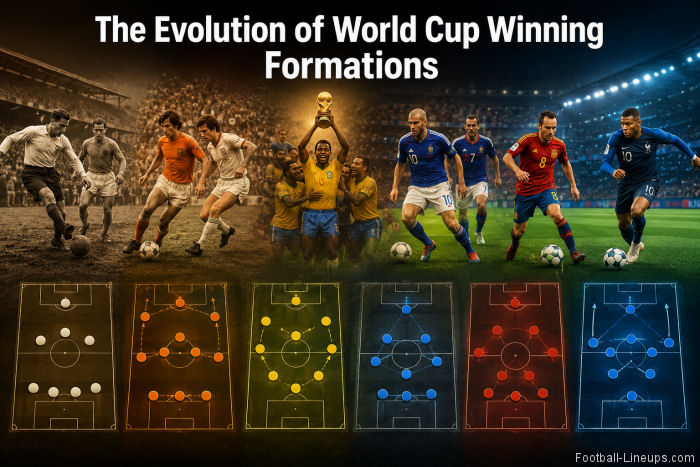
Football tactics are often remembered far more neatly than they actually happened.
Ask somebody how Spain won the 2010 World Cup and they will probably answer with "4-3-3". Ask about France in 2018 and the response becomes "4-2-3-1". Brazil in 2002? A famous back three supported by attacking wing-backs.
The temptation is to view World Cup history as a timeline of formations, with one system replacing another as football evolves. It makes for a tidy story. The reality is far less straightforward.
Anyone comparing favourites ahead of a tournament, whether studying tactical trends or researching World Cup Betting Sites, quickly discovers that successful teams are rarely defined by a single formation. More often, they are defined by their ability to adapt.
That distinction matters because football's tactical history is full of systems that were supposedly revolutionary until somebody found a way to beat them.
The Last Great Era of the 4-4-2
For much of the 1990s, the 4-4-2 was football's default setting.
Brazil won the World Cup in 1994 using a variation of it. France lifted the trophy in 1998 with a shape that would have looked familiar to supporters across Europe. The system offered balance, defensive stability and clearly defined roles. Full-backs defended, wingers provided width and strikers operated as a partnership.
Its decline was not sudden. Nor was it inevitable.
The problem was that football increasingly became a battle for control in midfield. Teams using three central midfielders began creating numerical advantages against opponents relying on a traditional midfield pair. Coaches adapted accordingly.
The formation itself never disappeared. It simply stopped being the answer to every tactical question.
Brazil's 2002 Team Changed Perspectives
Brazil's 2002 World Cup victory is often remembered through Ronaldo, Rivaldo and Ronaldinho.
The shape behind them deserves just as much attention.
With Cafu and Roberto Carlos operating as wing-backs, Brazil stretched opponents across the pitch while maintaining defensive cover. It was not a completely new idea, but it demonstrated how flexible roles were becoming.
Players were no longer restricted by traditional positional responsibilities. Defenders contributed to attacks. Midfielders drifted between lines. The game became harder to describe using static formations alone.
That trend has only accelerated since.
Spain's Influence Was Bigger Than Its Formation
Spain's World Cup-winning side in 2010 is frequently associated with possession football, but the lasting lesson was not simply keeping the ball.
Teams have always wanted possession.
What made Spain different was their ability to dominate central areas through players such as Xavi, Andrés Iniesta and Sergio Busquets. Opponents often found themselves chasing shadows not because of the formation on paper, but because of the technical quality and intelligence within it.
Many teams copied Spain's shape in the years that followed. Very few managed to copy Spain's control.
It was another reminder that formations alone rarely explain success.
Modern Football Is Less About Shapes
One of the challenges with discussing modern tactics is that formations often stop existing the moment a match starts.
Germany's World Cup-winning team in 2014 was usually listed as a 4-3-3. Argentina in 2022 regularly altered their structure depending on the opponent. France's 2018 side looked different when defending than when attacking.
This is why historical data on World Cup knockout matches produces an interesting conclusion. No single formation consistently delivers superior results. Variations of 4-3-3, 4-2-3-1 and even 4-4-2 have all enjoyed success.
The common factor is not the shape itself. It is flexibility.
The strongest teams adjust during matches, solve problems and exploit weaknesses as they appear. The formation provides a starting point, not a set of instructions that must be followed for 90 minutes.
More Than a Formation Board
The history of World Cup-winning formations is often presented as a story of tactical progress. One system rises, another falls and football moves forward.
The reality is less dramatic.
The best teams rarely win because they have discovered a magical formation. They win because they understand how to maximise the strengths of their players while adapting to the challenges in front of them.
That was true for Brazil in 2002, Spain in 2010 and Argentina in 2022.
The formation on the teamsheet still matters. It always will. But World Cup history suggests that adaptability matters more. The teams that lift the trophy are usually not those with the most fashionable system, but those capable of changing when the tournament demands it.
World Cup 2026 fixture