
How Football Lineups Slowly Changed From Fixed Shapes to Moving Ideas
These days, when lineups drop before a match, fans don’t just glance at them and move on. People zoom in, argue about shapes, and try to guess what the coach is really planning. You see this everywhere, from group chats to pre-match previews and even on apps like the betway app, where lineups often shift expectations before the ball is kicked. That wasn’t always the case. For a long time, lineups were exactly what they looked like.
When Positions Meant Exactly What They Said
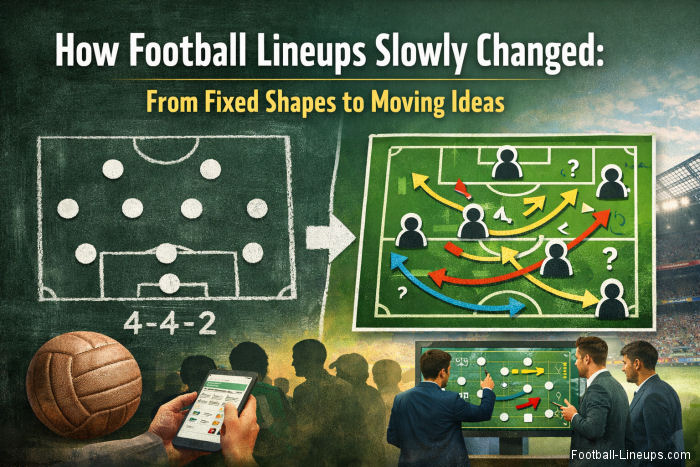
Go back a few decades and formations were literal. If a team lined up 4–4–2, that’s exactly how it played. Two strikers stayed high. Wingers hugged the touchline. Fullbacks didn’t wander. Players were judged on how well they performed their specific job, not how many roles they could cover. This worked because the game was slower and more predictable. Space existed in clearer zones, and movement was more limited. The shape stayed intact because there was no real reason to break it.
Defending Became About Space, Not Marking
One of the first big cracks in that thinking came when coaches started treating defending as a collective task. Arrigo Sacchi’s Milan sides are often mentioned here, but what really mattered was the idea, not the name. Defenders moved together. The line stepped up. Space behind the defense was controlled rather than chased. On paper, the lineup still looked familiar. On the pitch, it behaved very differently. Suddenly, the shape was alive.
Midfield Stopped Being a Link and Became the Game
As defenses got tighter, midfield stopped being a bridge between attack and defense and became the center of everything. That’s where formations like the 4–3–3 gained ground. Three central players gave teams control instead of balance. Under Pep Guardiola, this idea went further. The listed formation almost stopped mattering. Fullbacks drifted inside. Midfielders rotated constantly. The team shape changed depending on where the ball was, not where players started. Sergio Busquets wasn’t important because of speed or strength. He mattered because he knew where space would appear before it actually did.
Three at the Back Came Back for a Reason
For years, playing three defenders was seen as old-fashioned. Then coaches realized it could solve modern problems. A back three allowed teams to build safely, push wing-backs high, and still protect themselves when possession was lost. Antonio Conte showed this clearly. His teams didn’t sit back. They attacked aggressively, but from a structure that could absorb pressure. The lineup suggested caution. The football didn’t. That disconnect between what a formation looks like and how it plays became more common.
When the Striker Stopped Staying Up Front
Another quiet shift came when teams stopped treating the striker as a fixed reference point. The idea of a false nine forced defenders into uncomfortable decisions. Follow the forward and leave space behind, or hold the line and let midfield get overloaded. When Lionel Messi played centrally in this role, the formation on the team sheet became almost misleading. He wasn’t leading the line. He was breaking it. From that point on, lineups became clues rather than answers.
What Lineups Mean Now
Today, a lineup is just a starting position. A team might be announced as a 4–2–3–1, then spend most of the match attacking with five players across the front and defending with a deep block. Coaches plan for phases, not shapes. Possession shape. Defensive shape. Transition shape. The numbers only describe the first few seconds.
Why Fans Still Care About Lineups
Even knowing all this, lineups still matter. They signal intent. They tell you whether a coach wants control, caution, or chaos. A back three feels different from a back four. A midfield overload suggests patience. A front-heavy setup hints at pressure. Fans read those signals instinctively now, because football taught them how.
Final Thought
Lineups didn’t evolve overnight. They changed slowly, pushed by coaches solving problems and players learning to do more than one job. What used to be rigid became flexible. What used to be instructions became ideas. That’s why lineups today spark debate instead of certainty.
They’re no longer the plan.
They’re the first hint of it.