
How AI Is Changing Match Analysis and Tactical Predictions
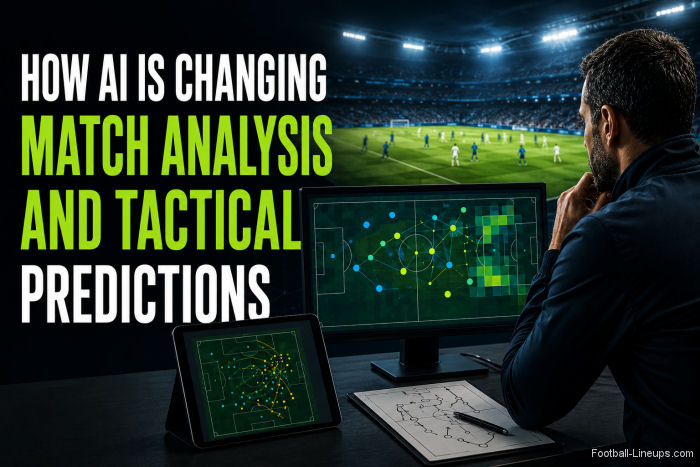
Football used to rely on clipboards, gut feeling, and hours of grainy video. Not anymore. Artificial intelligence has walked into the dugout — quietly, methodically — and it is not leaving.
The shift is enormous. According to a 2023 report by Statista, the global sports analytics market was valued at around $3.4 billion and is projected to reach $22.1 billion by 2030. Most of that growth is driven by AI-powered tools that analyze data faster than any human team ever could.
What AI Actually Does During a Match
Cameras. Sensors. Wearables. Every second of a professional match generates thousands of data points. AI systems process all of it in real time — player positions, sprint speeds, pressure zones, passing angles.
Tools like Opta, StatsBomb, and Hawk-Eye track over 2,000 individual events per game. That number would take a human analyst days to review. AI does it before the final whistle.
Reading the Opposition Before Kickoff
Here is where things get genuinely interesting. Coaches no longer walk into a match with a vague sense of what the opponent might do. They walk in with a probability map.
AI models analyze hundreds of past matches to identify behavioral patterns. Does the opposing striker drift left under pressure? Does their fullback push too high in the 70th minute? The algorithm knows — and now, so does the coach.
Tactical Predictions Are Not Guesswork Anymore
Predicting tactics used to be an art. Now it is closer to science. Machine learning models can forecast opponent formations with startling accuracy based on contextual triggers like scoreline, time of play, or player fatigue levels.
A study published by the MIT Sloan Sports Analytics Conference found that AI-driven tactical models could predict opponent pressing behavior with up to 72% accuracy. That is not perfect. But it is far better than intuition alone.
How Top Clubs Are Using This Right Now
Manchester City. Liverpool. Barcelona. These clubs have entire data science departments that work alongside coaching staff. The AI does not replace the manager — it informs them.
Liverpool's partnership with company Zone7 helps predict injuries before they happen. Their model reportedly reduced soft-tissue injury rates by up to 40% during one season. That kind of insight changes everything about squad planning and match preparation.
Player Heatmaps and Positional Intelligence
Heatmaps used to be a simple visual tool. Now they are layered, predictive, and contextual. AI systems generate dynamic heatmaps that update based on game state — not just where a player has been, but where they are likely to go next.
This matters tactically. If an AI model identifies that a winger consistently overloads the right channel when the team is losing, the opposition can set a trap. Smart teams are already doing exactly this.
The Role of Computer Vision
Computer vision is a big piece of this puzzle. AI systems trained on video can recognize formations automatically, classify pressing intensities, and even track off-ball movement that traditional stats completely ignore.
Companies like Sportlogiq and Metrica Sports offer this kind of video intelligence. Coaches can now ask questions like: "How much ground does our defensive line lose in the last 15 minutes?" and get a precise, visual answer in minutes.
Amateur and Youth Football Are Catching Up
This is not a technology that is exclusive to elite clubs. Websites such as Hudl, Wyscout, and Veo have enabled AI-based analysis to be available to lower league teams, academies, and even amateur teams.
The main difference between amateur games and games played by young clubs is that AI can't always gather enough information online. AI is highly data-driven, meaning it can be assisted. To gain a competitive advantage, analysts seek out hidden information. How? For example, they try to connect via CallMeChat and get to know the person who runs the stadium, where the next games will be, or who knows about team changes. This information doesn't necessarily have to be classified; it could be local rumors in the city where the team usually plays. Flexibility and creativity in lower divisions are much more important than simply trying to predict the outcome based on fragmentary data.
What Coaches Think About All This
Reactions vary. Some coaches embrace the data completely. Others remain skeptical. The tension is real — football is emotional, chaotic, human. Numbers cannot fully capture a decisive moment of individual brilliance.
Jürgen Klopp, in various interviews, acknowledged data as useful but insisted the human element remains irreplaceable. He is right. The best AI tools do not pretend to make decisions. They make better-informed decisions possible.
The Limits AI Has Not Solved
Momentum. Psychology. A player argument in the tunnel at halftime. These things do not show up in datasets. AI cannot model belief, confidence, or a locker room that has turned against its manager.
There is also the question of over-reliance. If every team uses the same AI models and the same metrics, tactical diversity could actually shrink. Innovation might come precisely from ignoring the algorithm — and trusting the instinct that no dataset can fully replace.
Where This Is All Going
Real-time in-game coaching suggestions are already being tested. Some leagues are trialing systems that alert coaching staff to tactical vulnerabilities as they emerge during a match — live, not at halftime.
The next frontier is generative AI that can simulate an entire match before it happens. Not just predict probabilities, but run thousands of virtual scenarios to find the optimal lineup and pressing shape. That future is closer than most people realize.
Final Thought
AI has not reinvented football. It has reinvented how football is understood. The game still happens on grass, with human legs and human decisions under enormous pressure.
But the preparation — the reading, the pattern recognition, the prediction — that part has been transformed beyond recognition. The coaches who learn to work with these tools well are not replacing their judgment. They are sharpening it.