
How Fans Around the World Follow Live Matches and Team Updates in 2026
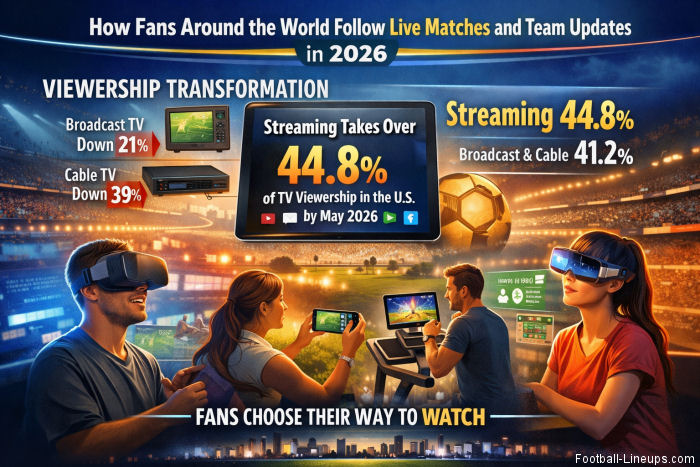
The traditional way in which fans from all over the globe were following live games and getting team news has been utterly changed. Sports fans have become the ones who decide the way, time, and place of the viewing of their favorite sports. Viewership of broadcast TV has been dropping every year since 2021, resulting in a total decline of 21%, while cable TV has fallen by 39%. By May 2026, streaming services accounted for 44.8% of TV viewership in the U.S., surpassing the total share of broadcast and cable for the first time ever.
These figures are indicative of much more than the mere technological evolution. We're standing at the brink of a radical transformation in the way sports lovers engage with their favorite games.
2026 Sports Viewing Landscape: Worldwide Shift
There are no longer any geographic restrictions on sports viewing. Fans in Tokyo can watch the European football leagues as smoothly as their local baseball. The popularity of American basketball is on the rise throughout the Asia-Pacific region. The reason for this worldwide reach is the streaming technology that is capable of delivering live content wherever you are, thus creating global sports communities that were inconceivable before.By 2026, over 118 million viewers in the U.S. will stream their favorite sports with an increase of 71% since 2021. The most fascinating part is that the fragmentation of sports media makes everything not less but more accessible. Instead of having the main run of live sports going through the traditional broadcasters, fans nowadays make their own personalized viewing experience by taking pieces from different platforms, browsing social networks, and using on-demand content that is compatible with their lifestyle.
Streaming Platforms Dominate Live Sports Access
Sports streaming platforms caused a disruption in the way people watch sports that goes far beyond consumption. These apps provide such enormous convenience that the very idea of conventional broadcasting may soon become a relic. At the same time, the rivalry among streaming platforms only serves to step up the pace of innovation. Now, apart from live games, you find real-time stat overlays, social features allowing everyone around the world to connect, and interactive experiences unavailable on traditional TV.Platform Success Stories
Peacock's rise powered by the sports rights it holds exclusively has been phenomenal. In the fourth quarter of 2024, the streaming platform recorded 36 million subscribers, which was an increase of 29% compared to the previous year. Through the exclusive streaming rights to the Paris 2024 Olympics, the live viewers increased by 33%. Such high-profile events significantly accelerate the transition to streaming.It was a bundle strategy combined with unique content that helped ESPN+ to make a smart play. Their studio programs like Get Up broke records with 424,000 average viewers, marking the highest level of ESPN since 2017. The platform was responsible for 65% of the total sign-ups through the Disney bundle integration.
DAZN expanded its reach to the outside world market, and through rights acquisitions and mobile optimization, the company is enjoying 40% growth in global subscribers audience.
Free vs. Premium Streaming Models
Free streaming pulls in broad audiences with ad-supported models, while premium subscriptions offer the enhanced experience: ad-free viewing, 4K quality, and exclusive behind-the-scenes content. Dedicated fans often find these perks worth the subscription cost. Many viewers play both sides, using free services for casual watching and premium platforms for can’t-miss events.In a fragmented streaming landscape, some fans also rely on tools that help manage access across regions or navigate geo-restrictions, ensuring they can follow their favorite competitions without interruption. For example, fans often use CyberGhost VPN free trial to test solutions that make international streams accessible while maintaining flexibility in viewing options.This lets users explore secure, encrypted connections, choose from multiple server locations worldwide, and experience unrestricted access to streaming content—all without committing to a subscription.
Social Media as the Second Screen Experience
The rise of social media has completely altered the way people experience entertainment. What used to be a purely passive activity suddenly became one that involved various forms of participation. Viewers no longer simply sit in front of their TV screens and watch a game; they simultaneously carry on conversations with fellow fans all over the world via social media. These different communication channels add to the excitement and make the experience more vibrant and captivating.At the same time, highlight reels from various games are shared everywhere by the second. The videos reach millions of people within minutes and thus carry the very essence of sports beyond the fan base that traditionally has always been closely tied to the sport itself. These short videos serve as stepping stones for bringing in the non-traditional audiences. They result not only in the exposure of new sports to casual viewers but also create opportunities for them to get familiar with stars.
Fan groups energize each other and play the stadium role by exchanging comments in real-time. In this case, the fan pages of teams and leagues supplement content with attractive features, allowing fans to contact the respective teams directly.
Mobile Apps: Command Centers for Modern Fans
Sports apps have become central hubs of the modern fans' experience. They offer live scores, breaking news, and notifications personalized exactly to one's preferences. The users set alerts for their favorite teams, players, or competitions thus avoiding a lot of useless updates.Apart from that sports-only apps display the whole set of statistics, injury updates, and tactical analysis. Features such as betting and fantasy sport integration add interactive dimensions that result in a deeper level of immersion. You are able to adjust your fantasy lineups, place bets and monitor predictions simultaneously with live action. Thus, the viewers become the players.
Interactive Technologies Transforming Fan Engagement
Continuous innovation changes the way fans are engaged with live sports. The use of multi-angle camera control allows fans to pick spots that they pay attention to, e.g. focus on the favorite players or the tactics. Each person watching the same broadcast in a different way thus creating their own experience. Embedding features such as polls or trivia during streaming adds the element of gamifications of watching which is rewarded with points or prizes. AI-driven systems purposefully help people to find out about those games or content that they are most likely to be interested in based on their previous viewing history.Regional Differences in Sports Consumption Patterns
People's consumption of sports is very different in various parts of the world due to factors such as availability, cultural tastes, and the level of market development. There is cord-cutting happening at full speed in North America where the use of streaming is being embraced particularly by the youth. Out of sports fans exclusively using digital channels, 40% nowadays use streaming to get games instead of traditional TV broadcast.It's mainly the younger ones who are responsible for this transition. 56% of viewers streamed digitally the 2021 NCAA March Madness. North America is the stronghold with established leagues and continuous growth while U.S. accounts for 81.2% of the regional sports tech revenue share.
While Europe still relies heavily on big events like UEFA Champions League, it matures through the resolution of a situation with the broadcasting rights which has been tricky for a long time.
Different deals determine the availability and pricing of the content in different countries. Asia-Pacific is the Mobile-first player and the market-leader showing the fastest growth, that is mostly because of increased disposable incomes, digital platforms such as Tencent Sports, and popular sports such as cricket and soccer. The companies in India and China are at the forefront.
Overcoming Barriers to Global Sports Access
Language options and local commentaries essentially break down the cultural barriers and help the audiences worldwide to engage fully with the international competitions. Affordable data plans and streaming platforms, which are optimized to a minimum requirement, can reduce the cost even in the markets that are very price-sensitive. The problem of time zones makes it difficult for global audiences to view live the events. However, on-demand replays solve this issue. So fans can watch the games whenever it is convenient for them which is very crucial in the development of international fan bases.Emerging Technologies Shaping the Future
Virtual and Augmented reality are expected to offer great experiences that will enable the fans to be in the courts even while at their homes. The very first users are already experimenting with VR broadcasts which digitally recreate the arena atmospheres. The 5G networks will allow the enhancement of streaming quality to a level where it will become completely smooth multi-angle viewing plus the removal of one of the biggest frustrations of streaming,targeting the buffers. Ultra-low latency will also allow the user to feel that the interaction at real time is almost instantaneous.How Fans Navigate the Fragmented Sports Media Landscape
Digital live sports viewing is expected to grow at a rate of 8.3% annually in 2026, which is projected considering the current trends and the recent performance of platforms.In order not to miss out on any content, fans devise clever ways to combine multiple platforms so to have comprehensive coverage. One account on an aggregator and hubs of the sports news help to simplify the discovery of the content by picking the highlights and updates across the competitions, so fans can be helped to navigate the complexity of the games with no pain of missing the crucial moments of their favorite players and teams.
The way sports have been consumed has changed due to not only the advancement in technologies but also the viewer's expectations. Streaming gives the viewers a chance to have flexibility and access beyond what they had ever seen, but the whole scene is still complicated. The challenges due to fragmentation, the gaps of regional access, and the difference between the quality of the services still exist. As the platforms continue to be innovative and competing for the rights, the fans by all means should get the increased options but they must be well-equipped to navigate the increasingly intricate ecosystem to be able to follow thoroughly their favorite games.
World Cup 2026