
How Pre-Match Formation Boards Can Mislead Fans Before Kickoff
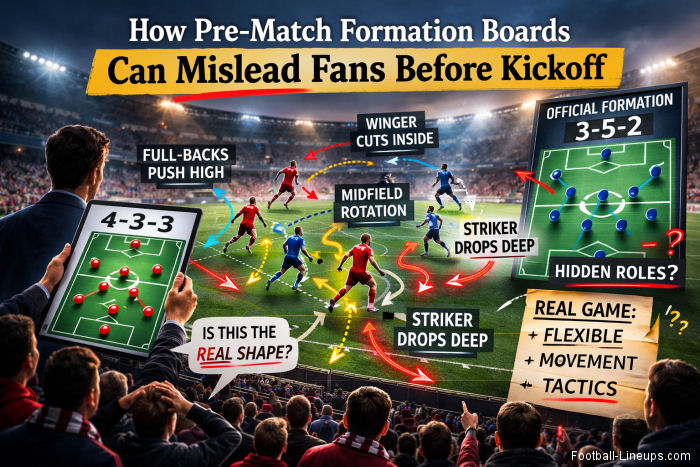
Before every match, fans rush to see the team sheet. Then comes the formation board. It looks simple and clear. A 4-3-3 seems to mean one thing. A 3-5-2 seems to mean another. TV shows small circles on the screen, and social media shares them right away. It all feels settled before the ball even moves. But football is rarely that tidy. The shape shown before kickoff is often just a rough guide, not the full truth.
Why The Announced Shape Looks More Exact Than it Really is
A formation graphic has one main job. It must simplify the team fast. That helps viewers, but it also creates a problem. Real football roles overlap. Wingers drift inside. Full-backs push high. Midfielders rotate. One striker may drop deep while another runs beyond. A flat image cannot show all that movement. It freezes a living system into a still picture. Fans then read it as fact, even though it is often closer to a guess, like it is in UFC betting.
Managers Do Not Always Reveal The Real Plan
Sometimes the public lineup hides as much as it shows. Coaches know that opponents study every detail. They also know fans and media react fast. So they may list players in familiar roles while planning something else. A right-winger may actually start narrow. A central midfielder may step into the back line. A striker may spend the opening phase pressing like a second attacking midfielder. None of that must appear on the team sheet. The paper may be honest, yet still incomplete.
Some Players Break The Graphic On Their Own
Every era has players who refuse to fit neatly into one dot on a board. They are not being chaotic. They are just flexible. Think of a full-back who plays like a midfielder, or a winger who moves into the middle. Think of a striker who drops deep and moves defenders away. These players improve the game, but they also make pre-match graphics look too simple. One role on paper can hide three jobs in the field.
Hybrid Roles Make Static Diagrams Weak
The game now loves hybrid players. Coaches ask defenders to step into midfield. They ask midfielders to cover wide channels. They ask forwards to press, create, and finish. A simple lineup board cannot track that blend. It can label a player as a left-back, but that player may spend long periods acting like an extra midfielder in buildup. Fans who trust the board too much may think the team is disorganized, when in truth the movement is planned.
Star Players Often Pull The Shape Out Of Line
There is another wrinkle. Great players earn freedom. A manager may build the structure around a roaming player. That freedom bends the formation from the start. The team may be named in a 4-3-3, but if the best attacker keeps drifting inside, the shape changes at once. Teammates react. The full-back overlaps. The winger on the other side stays wider. One small freedom creates a chain of movement. The original board then looks too stiff to explain what is happening.
Early Match Context Also Reshapes The Team
Football does not happen on its own. The other team matters. The score matters. Even the mood in the stadium can matter. One team may start carefully, then press more after a few minutes. Another may defend deep from the start because the other side is strong out wide. Some coaches also use the first few minutes to test things before playing more aggressively. So the opening shape may differ from both the lineup board and the long-term game plan.
Fans Should Watch Relationships, Not Just Rows
This is the best way to read a real formation. Do not stare only at the horizontal lines of players. Instead, watch connections. Who drops near the center-backs? Who stays high and wide? Which full-back moves first? Does the striker pin defenders or roam away? Does one midfielder hold position while another runs ahead? Those relationships tell the truth much faster than a graphic does. Formations are useful labels, but football is really about duties, spacing, and timing.