
Impact subs at the 2026 World Cup
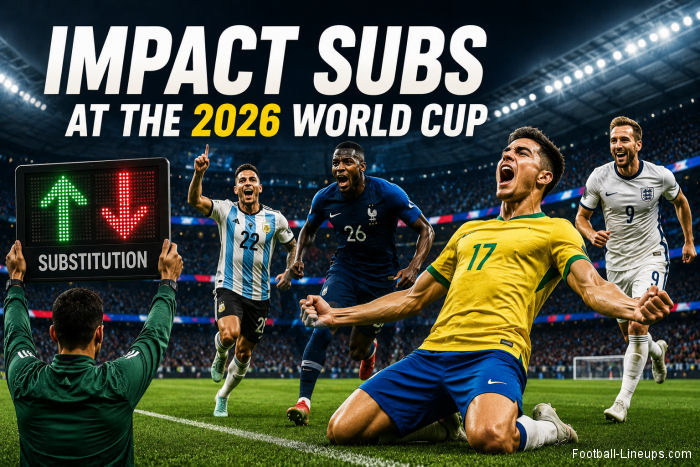
Substitutes have become one of the defining stories of the 2026 World Cup. The expanded 48-team format, demanding travel schedule, and the heat of a North American summer have forced managers to rely on their squads more than ever before. Fresh legs are no longer simply a tactical option—they have become a decisive weapon capable of changing matches in a matter of minutes.
This growing importance of squad depth has also influenced the FIFA World Cup 2026 odds, as teams with stronger benches have consistently found ways to rescue points or secure victories late in games.
From record-breaking goals to dramatic equalizers and match-winning cameos, substitutes have delivered some of the tournament's most memorable moments. Here are several players who have made the biggest impact after coming off the bench.
Mattias Svanberg
Sweden's Mattias Svanberg needed just 18 seconds to leave his mark against Tunisia. His strike became the second-fastest goal scored by a substitute in World Cup history since 1966, behind only Richard Morales for Uruguay in 2002. The goal completed a convincing 5-1 victory and highlighted how instantly a substitute can influence a match.
Helio Varela
Cape Verde have been one of the tournament's biggest surprise packages, and Helio Varela added another memorable chapter against Uruguay. Only three minutes after entering the match, he scored the equalizer in a 2-2 draw, helping the World Cup debutants earn a famous point against the two-time champions. For a nation of around 525,000 people, it was another historic moment.
Deniz Undav
Germany found their inspiration on the bench through Deniz Undav. Trailing Ivory Coast 1-0 and facing elimination, the Stuttgart forward came on and scored twice to complete a dramatic 2-1 comeback victory that secured Germany's place in the knockout stage. It was also the second time he had scored as a substitute during the tournament.
Marcus Rashford
England eventually overcame Croatia thanks to Marcus Rashford's late contribution. Introduced for Anthony Gordon, Rashford scored to seal a 4-2 victory after Harry Kane's earlier brace. His performance demonstrated England's impressive attacking depth, although Thomas Tuchel arguably waited too long to introduce him in the earlier goalless draw against Ghana.
Bradley Barcola
France's strength in depth was on full display against Senegal. Just two minutes after replacing Ousmane Dembele, Bradley Barcola raced onto an Adrien Rabiot through ball before calmly chipping the goalkeeper to help secure a 3-1 victory. Alongside Kylian Mbappe's contribution, Barcola's impact underlined the depth of France's attacking options.
Johan Manzambi
Switzerland's Johan Manzambi enjoyed a breakthrough performance against Bosnia and Herzegovina. At just 20 years and 247 days old, he came off the bench to score twice in a 4-1 victory, becoming the youngest substitute in World Cup history to score a brace. His spectacular volley, scored only three minutes after entering the match, was one of the goals of the tournament.
Nadhir Benbouali
Algeria's comeback victory over Jordan began with the introduction of Nadhir Benbouali at half-time. The forward headed home a Riyad Mahrez corner to cancel out Jordan's opener before Algeria completed a 2-1 turnaround. His goal kept Algeria's World Cup hopes alive while ending the debutants' campaign.
The 2026 World Cup has reinforced the value of squad depth in modern football. Managers are increasingly winning matches not only with their starting XI but also with the quality they can introduce from the bench. With substitutes already contributing more than 25 goals during the tournament, the trend is impossible to ignore. As the knockout rounds become tighter and physical demands continue to rise, expect impact substitutes to play an even bigger role in deciding who ultimately lifts the World Cup trophy.
World Cup 2026 fixture