
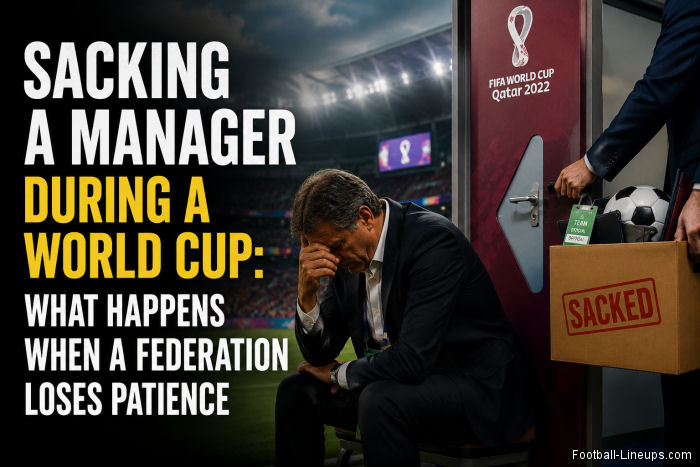
Reaching a World Cup is an achievement that most nations spend years working towards. Qualifying campaigns stretch across two years, squads are assembled with the tournament in mind, and managers are appointed to build something with that specific endpoint in view. It makes the decision to dismiss a head coach during the 2026 FIFA World Cup all the more striking. Sacking a manager during a World Cup is one of the rarest moves in international football because it means a federation has concluded that keeping the current coach would cause more damage than replacing him while the tournament is still underway.
Tunisia became the first managerial casualty of the 2026 World Cup, with Sabri Lamouchi dismissed within hours of a 5-1 defeat by Sweden in Monterrey. For a modern digital bookmaker pricing up Group F before the tournament, Tunisia were given little chance of progressing in the first place, but a five-goal opening defeat pushed the federation to act regardless of what the remaining group-stage matches might bring.
Herve Renard was quickly confirmed as his replacement until the end of Tunisia's World Cup campaign, with the Frenchman arriving to prepare the squad for fixtures against Japan and the Netherlands.
Why federations make the call
A mid-tournament dismissal is rarely about the remaining games. By the time a federation moves, qualification is usually beyond reach, and the decision is as much about managing domestic and political fallout as it is about football.
In Tunisia's case, the pressure had been building before Lamouchi even arrived in North America. He had taken charge in January and won just one of his five games in that time, a 1-0 victory over Haiti in March. Two warm-up defeats in the weeks before the tournament, 1- 0 to Austria and 5-0 to Belgium in Brussels, had already tested patience at federation level. The 5-1 defeat to Sweden tipped the balance.
Federations in North Africa and the Middle East have historically been less tolerant of poor results on the international stage, where the national team carries a cultural and political significance that amplifies the fallout from a heavy defeat. Changing the manager signals to supporters and the squad that the current direction is not acceptable, even when that signal arrives too late to change the group stage outcome.
How the process works
There is no universal protocol for dismissing a manager during a World Cup. Federations operate under their own governance structures, and the logistics vary considerably.
Tunisia announced Lamouchi's departure on the federation's Instagram account, confirming the contract had been terminated by mutual agreement. He had been appointed on a deal running until 2028, so a compensation settlement will follow in the weeks ahead. Finding a credible replacement at short notice, with a squad already in tournament mode, is a considerable challenge. Renard was available, having parted ways with the Saudi Arabia men's side in the build-up to this tournament, and his record of two Africa Cup of Nations titles and the man who led Saudi Arabia past Argentina at Qatar 2022 gave the appointment an immediate authority that the situation demanded.
It has happened before
Tunisia have been through this before. In 1998, they sacked Henryk Kasperczak during the World Cup in France, though he was at least given two games before the federation acted. South Korea dismissed Cha Bum-kun during the same tournament. Julen Lopetegui was removed by Spain just two days before their opening game at Russia 2018 after he agreed to take the Real Madrid job without informing the federation first, which is a slightly different scenario but illustrates how quickly associations will act when they feel their authority has been undermined.
The pattern across all of these cases is similar: a federation decides that the reputational cost of doing nothing outweighs the operational disruption of making a change with the tournament already underway.
A harsh verdict on a short reign
There is a fair argument that Lamouchi was hard done by. He inherited a squad with limited resources against some of the toughest opponents in Group F, and five games is a minimal foundation from which to judge a manager's capabilities. Tunisia were always going to face an uphill task against the Netherlands and Japan regardless of what happened in Monterrey.
The 5-1 scoreline was damaging, but it was one result, and Lamouchi had been building with the squad for less than six months. Renard takes over with two group games remaining and, by any realistic measure, a tournament that is already over for Tunisia.
Conclusion
Managerial dismissals during a World Cup remain exceptionally rare because the disruption they create almost always outweighs any tactical benefit. When they do happen, they usually reflect months of mounting pressure rather than a single poor performance. Tunisia's decision to replace Sabri Lamouchi with Herve Renard is another reminder that, for some federations, protecting the long-term credibility of the national team can become more important than preserving stability during football's biggest tournament.
World Cup 2026 fixture