
The Role of Substitutes in Football: How Bench Players Change Matches
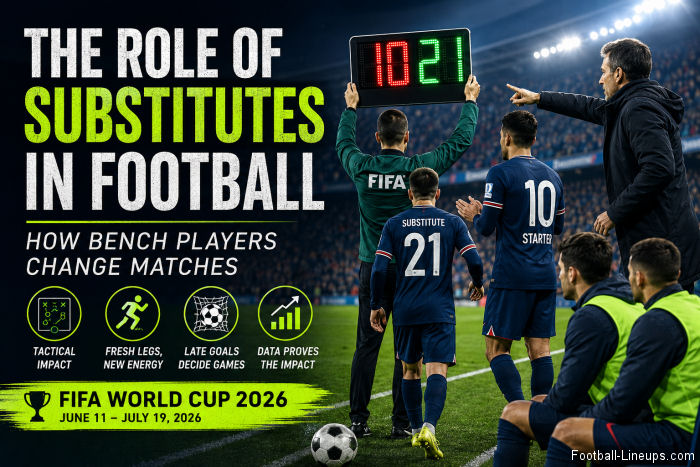
Substitutes no longer exist to kill the final five minutes. They decide pressing shape, rest defense, counter-attacking lanes, set-piece height, and late-game shot volume. Since the five-sub era became standard in elite football, the bench has become a second tactical plan rather than a list of tired alternatives. With the FIFA World Cup 2026 approaching from June 11 to July 19, managers will treat substitutes as tournament weapons rather than emergency options.
Why Substitutes Matter More in Modern Football
The 65th minute is not magic, but it is a useful tactical border. Legs are heavier, full-backs defend wider spaces, midfielders stop arriving on time, and center-backs begin to protect depth rather than squeeze forward. That is when the right substitute changes the geometry of a football match.
A winger against a booked full-back is not simply "fresh legs." It is a targeted attack on a specific weakness. A second striker can pin one center-back and open the half-space for runners. A controller can slow the match just as the opponent becomes emotionally reckless.
This is why reactive substitutions often look late. The best coaches do not wait for a goal against. They see the next problem before the crowd sees the current one.
How the Five-Sub Rule Changed Football Tactics
The five-sub rule changed how squads are built. A coach can now plan two waves: one around the hour mark and another in the final 10 to 15 minutes. That turns the bench into a resource allocation problem.
Competition regulations in many elite leagues now allow five substitutes across three substitution windows. The practical effect is clear. Managers can alter nearly half an outfield team without losing structure.
The World Cup adds another layer. Heat, travel, group-stage intensity, and recovery windows will make bench depth a major factor in 2026. Squads with specialists — not just famous starters — should age better across the tournament.
Data Shows Substitute Goals Are Increasing
Exact cross-league percentages for goals scored by substitutes after the 65th minute are not published consistently across all major leagues. The available data still points in the same direction: late goals and substitute goals have increased as added time and five-sub usage have expanded.
The Premier League reported during the 2023/24 season that substitute goals were rising significantly compared to previous campaigns. Across Europe's major leagues, clubs increasingly rely on bench players to change matches late.
That is not a footnote. That is a selection policy.
How Football Substitutions Influence Live Betting Markets
Late substitutions matter because live markets often move faster than post-match narratives. A coach introducing a runner, a target man, or a second pivot after 65 minutes changes totals, next-goal pricing, corner pressure, and card risk. Basketball fans have long understood how bench rotations can change a game within minutes, and football is increasingly following the same pattern.
Audiences often consume sport in short sessions between matches, highlights, and live-score updates. The same demand for quick access and clear information is seen across digital entertainment platforms. For example, an online casino typically highlights game providers, RTP information, volatility, and demo modes so users can make informed choices quickly. In football, understanding how substitutes alter momentum offers a similar advantage when analyzing matches in real time.
Jürgen Klopp and the Art of Impact Substitutions
Jürgen Klopp used substitutions as pressure injections. At Liverpool, his best bench moves often added running power, counter-pressing aggression, or penalty-box chaos rather than tidy possession. Divock Origi became the symbol because he changed emotional temperature as much as shape.
Liverpool regularly produced late winners from substitutes during Klopp's tenure. That was not random romance. It reflected a team that kept attacking structure alive late, overloaded tired defenders, and made the final phase feel physically unfair.
Klopp's classic substitute pattern had three forms:
- Add a direct runner against a full-back who had stopped stepping out.
- Add a penalty-box striker when crosses and second balls were arriving.
- Add midfield energy to keep the counter-press alive after the front line faded.
The substitute was not a rescue plan. It was the final phase of the original plan.
Diego Simeone's Tactical Use of Bench Players
Diego Simeone works differently. His substitutions often protect match state first, then attack the weakness that appears when the opponent overcommits. Atlético Madrid have repeatedly demonstrated how effective bench players can be when used with a clear tactical purpose.
Simeone's late changes generally follow three patterns. First, he adds legs to the wide channels to survive pressure. Second, he introduces a forward capable of attacking the space behind a team chasing the game. Third, he refreshes midfield duels so Atlético can continue disrupting rhythm and closing passing lanes.
That is why Atlético substitute goals often feel like punishment. The opponent thinks the match has opened. Simeone has simply waited for the door to swing the wrong way.
When Substitutions Fix Tactical Mistakes
Not every late change is tactical genius. Some substitutions only repair a poor starting plan. A winger enters because the original setup lacked width. A defensive midfielder arrives because the first pairing could not manage transitions. A striker is introduced because the team spent 70 minutes crossing to nobody.
The difference between surgical and reactive substitutions is timing. Surgical changes preserve the coach's logic. Reactive changes admit the coach misread the game.
The crowd often cheers both equally. The data does not.
What to Watch at the FIFA World Cup 2026
The 2026 World Cup will stretch squads harder than previous editions because of the expanded 48-team format, wider travel map, and summer conditions across the United States, Canada, and Mexico. Substitution timing should become one of the clearest indicators of serious contenders.
Watch for teams that change role without changing identity. A favorite can introduce a second striker and still press effectively. A defensive side can add attacking quality without losing organization. Poorly constructed squads simply swap names.
Conclusion
Football substitutions have evolved from simple squad management into one of the sport's most important tactical tools. Modern substitutes can increase pressing intensity, create new attacking patterns, protect leads, or exploit tired opponents. As teams prepare for the FIFA World Cup 2026, squad depth and the intelligent use of bench players may prove just as important as the quality of the starting eleven. The teams that manage substitutions best could gain the decisive edge when knockout matches are won and lost in the final minutes.
The bench will tell the truth before the knockout bracket does.