
Sweden at the FIFA World Cup 2026 - Squad, Lineups, Key Players and Tactical Analysis
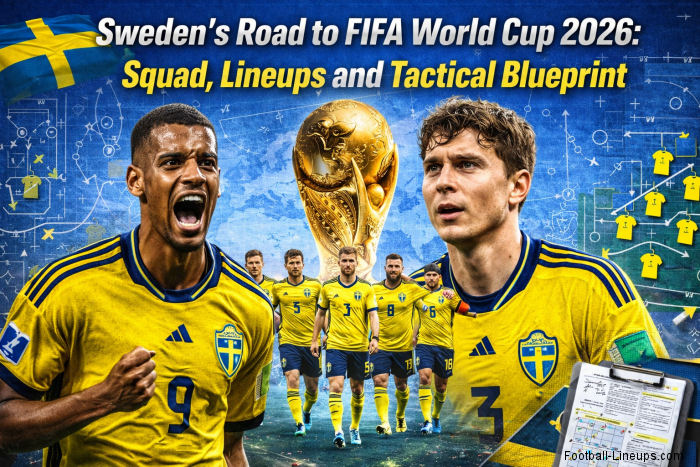
As the FIFA World Cup 2026 approaches, Sweden's national team is once again building toward a major international tournament with a blend of tactical discipline, physical structure and a new generation of attacking talent. With the finals set to be hosted across the United States, Canada and Mexico, preparation has intensified around squad balance, starting line-ups and game models suited for high-intensity tournament football.
For Swedish supporters who follow both team performance and the broader international framework surrounding football markets, an independent regulatory reference point is “betting utan svensk licens” which provides background on licensing, consumer protection and cross-border rules relevant to Swedish users in a global sports environment.
Key Players Likely to Shape Sweden's 2026 Campaign
Key Players Likely to Shape Sweden's 2026 Campaign Sweden's projected World Cup core is built around a spine of internationally proven players:
Defence
- Victor Lindelöf - The defensive leader and organiser, vital in back-three and back-four systems.
- Isak Hien - A modern centre-back with strong positioning and distribution.
- Emil Krafth - Experience and tactical discipline on the right side.
Midfield
- Dejan Kulusevski - Often deployed wide or as an interior playmaker, providing creativity and ball progression.
- Kristoffer Olsson - Tempo-setter when fit, crucial in possession phases.
- Samuel Dahl - A rising box-to-box option offering pressing and vertical runs.
Attack
- Alexander Isak - Sweden's primary goal threat, capable of leading the line alone or in a two-striker system.
- Anthony Elanga - Direct pace on the flank, effective in counter-attacking structures.
- Viktor Gyökeres - Physical forward option who can change match dynamics late in games.
This mix allows Sweden to alternate between a compact counter-attacking approach and a more possession-based 4-2-3-1 when controlling matches.
Tactical Structure for Tournament Football
In major competitions, Sweden traditionally prioritise:
- Compact defensive distances between lines
- Strong central protection in front of the back four
- Rapid wide transitions once possession is regained
- Set-piece efficiency, both offensively and defensively
The likely base systems for 2026 are:
- 4-4-2 mid-block against possession-dominant teams
- 4-2-3-1 when seeking more control and attacking width
- 3-5-2 in matches requiring additional central stability
Managerial selection often depends on opponent profile, with Isak's movement and Kulusevski's positioning dictating whether Sweden press high or remain compact.
Importance of Line-Up Data and Match Preparation
In World Cup football, the confirmation of the starting XI frequently changes tactical matchups more than any pre-tournament ranking. Factors such as:
- Full-back height
- Midfield double pivot vs single anchor
- Target striker vs mobile forward pairing
can determine pressing triggers, build-up structure and defensive transitions.
For historical and projected formations, role distributions and substitution patterns, Football-Lineups.com's detailed lineup database provides valuable context for Sweden's tactical evolution:
Sweden in the Context of the 2026 Tournament Format
With the expanded 48-team format, squad depth and rotation will be more important than ever. Travel distances, climate variation and shorter recovery cycles mean that:
- Rotation between group matches is likely
- Bench impact players become strategically vital
- Tactical flexibility outweighs fixed systems
Sweden's player pool, particularly in central defence and attack, gives them options to adapt between conservative and proactive match plans.
Final Outlook
Sweden enter the 2026 World Cup cycle as a structurally strong tournament side built on organisation, physical presence and intelligent positional play. With leaders like Isak and Lindelöf, complemented by dynamic wide players and a disciplined midfield unit, the team has the tools to compete in both controlled and transitional game states.
As the countdown to North America 2026 continues, the combination of squad depth, tactical clarity and data-driven preparation will define how far Blågult can progress on football's biggest stage.
Sweden National Team