
Team Lineups and Tactical Choices Shape Fifa World Cup Favourites
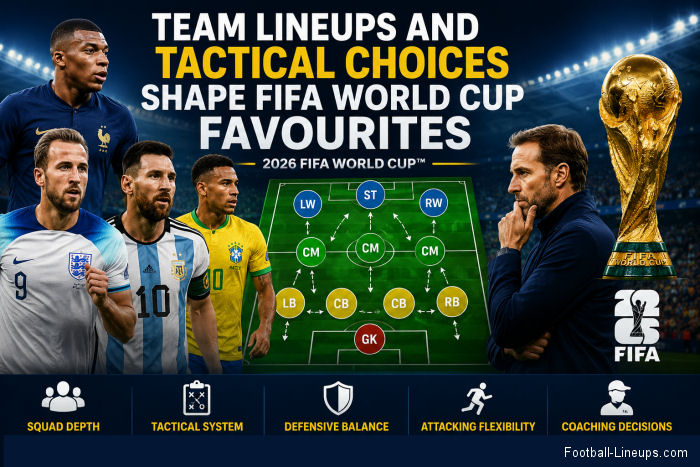
Based on recent news coverage and ongoing discussions across social media, excitement surrounding the 2026 FIFA World Cup is already building rapidly. Even people who do not usually follow football closely are talking about the tournament and hoping to see their countries succeed. Many fans have also increased their interest through FIFA World Cup betting, while others are simply sharing predictions and debating which teams look strongest ahead of the competition.
But what factors are people using when choosing the teams they believe can win the tournament? Are supporters simply backing their favourite national sides, or are they paying closer attention to tactical details, squad depth, and team chemistry? Increasingly, conversations are focusing on projected starting lineups, coaching decisions, and the ability of teams to adapt tactically against different opponents.
Modern football analysis now goes far beyond star players alone. Fans and analysts regularly discuss formations, pressing systems, defensive balance, midfield control, and attacking flexibility when evaluating World Cup contenders. A team with a strong tactical identity and reliable squad rotation is often viewed as more capable of surviving the demands of a month-long tournament.
Social media platforms have amplified these discussions, with supporters debating everything from possible front-three combinations to defensive partnerships and substitute options. Managers are also under constant scrutiny, as tactical adjustments during knockout matches can completely change the direction of a tournament campaign.
As the 2026 FIFA World Cup approaches, team lineups and tactical choices are becoming central to how fans, analysts, and even casual viewers judge the favourites. While passion and national pride still play a major role, football conversations today are increasingly shaped by strategy, data, and the fine details that can decide matches at the highest level.
How Are People Choosing Which Teams to Back?
This year’s FIFA World Cup will see 48 nations compete and will thus be the largest of its kind to ever take place. Not only will this expansion open the doors to more countries to participate, but it will also appeal to more people who want to wager on their home countries. But are people really making subjective decisions when it comes to their wagers, or are they putting more thought into their bets? Well, according to the current stats, people are making informed bets by focusing on the following factors:
The Team Lineup
People who are betting on teams, including seasoned punters, are very keen on checking team lineups so as to see whether the star players will be in the starting eleven. That is because bettors are able to compare star players in one team against the stars in another team so as to figure out which team has the upper hand. For example, where a tall striker in team A will face a short defence in team B, then team A is seen to have the better chances.
Naturally, star players may fail to be present because of reasons such as injuries or even team rotations. In such cases, this absence weakens the team’s odds as it reduces people’s confidence in the lineup. So far, teams that have been predicted to have the strongest lineups have been enjoying the most favourable odds. However, this can always change in the days leading up to the matches.
But it is not only the star players who are getting people’s attention. Bettors are also looking at the substitutions (subs) who may be asked to play at some point during the matches. Just like with star players, teams with the strongest subs have the better odds, as these subs can come in handy when trying to score late goals, especially during tight matches.
The Formation
Every coach gets to choose a team formation based on their opponents. Sometimes, coaches choose to play aggressively to score more goals. And at others, they choose to play defence, especially when they are going against a stronger and more aggressive team. Bettors consider these decisions when making their wagers. Why?
When coaches choose to play defensively, this lowers their goal expectations. As such, bettors focus on wagers such as “under”, but where coaches choose to play aggressively, they turn to “over” bets. These formations also give bettors an inkling of the coach’s confidence in winning a game and can help them determine whether backing a team is in their best interests.
At this time, most team formations are still not set in stone, and bettors are basing their decisions based on historical team performances. Come the time of the matches, bettors will be able to see the tactics in play and will be in a better position to make live bets based on what is on display.
Are There Any Top Teams?
With bettors weighing teams against each other, it comes as no surprise that the following teams have won favour worldwide:
- Spain : Many bettors praise this team for its youthful and strong starting lineup.
- Argentina : As the defending champions, they already have a knack for winning.
- France : This team is known for its high adaptability, more so when it comes to formations.
- England : Its consistency over the years works in its favour.
- Brazil : When it comes to skilled attacks, this team is a clear winner.
Of course, any of the other 43 teams also stand a very good chance of winning, as these are just the early predictions.
World Cup 2026