
Why Formations and Shapes Moves the Odds in the Hour Before Kickoff
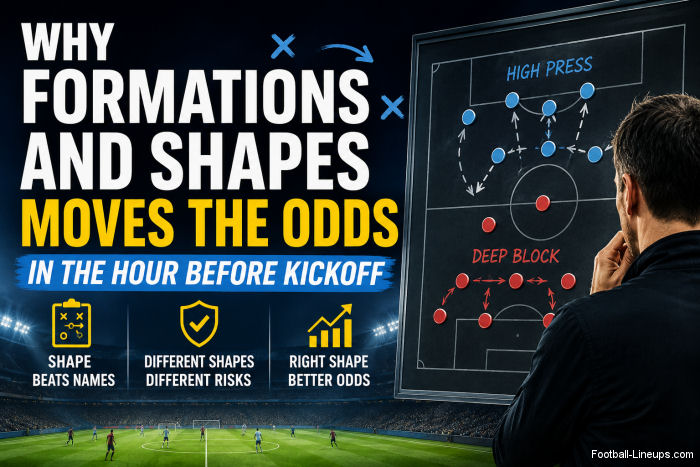
Managers spend more hours drilling a defensive line than they do preparing set pieces, yet broadcast coverage still spends most of its time on individual duels. The shape a team plays, not the eleven names filling it, decides far more knockout football than most build-up shows admit. A high press and a deep block are not just stylistic preference. They carry entirely different risk profiles, and once a match kicks off, those profiles start bending the live odds within minutes.
The FIFA Technical Study Group's match report hub for this tournament has already flagged mid-block and low-block transitions as one of the defining stories of the group stage, and that framing holds up when you compare progression rates across formations.
The High Press Carries Reward and Risk in Equal Measure
A 4-3-3 built around an aggressive press asks forwards to defend from the front and full-backs to push high, betting that recoveries in dangerous areas will outweigh the space left in behind. When it works, the eye test and the underlying numbers agree completely. Turnovers climb, transition chances multiply, and matches get settled inside twenty seconds of winning the ball back.
When it breaks, it breaks fast. One missed press trigger and a back four is exposed against a two-on-one, which is exactly why pressing sides tend to produce the highest-variance results at a tournament. They win big and lose big far more often than settled, patient opponents.
Live Odds React to Shape Changes Almost Instantly
Bookmakers do not wait for a goal to move a price. A substitution that signals a switch from a back four to a back three gets absorbed into in-play markets within seconds, because it changes the expected number of clear chances for the rest of the match.
If you’re engaged in the current in-play World Cup betting markets, you’ll have noticed this already. Prices tighten or drift the moment a manager reaches for the fourth official's board, often before the substitute has even reached the touchline.
The same logic applies to pre-match pricing. A manager with a settled record of switching to a low block when protecting a lead should be priced differently in under-goals markets than one who chases every game at the same tempo regardless of the scoreline.
Deep Blocks Trade Excitement for Control
A 5-4-1 or a compact back three flips the calculation entirely. Possession is conceded willingly, the defensive line barely moves, and the entire structure is built to force opponents into shots from range or crosses into a crowded box.
It rarely produces the kind of highlight reel that dominates a broadcast, but it is remarkably difficult to break down over ninety minutes. Teams that commit to this shape tend to concede fewer clear chances across a tournament even when they hold the ball far less than their opponents.
This is the shape that consistently frustrates markets pricing in goals. A deep block does not need to dominate a match to survive it, and pricing that assumes territorial control equals scoring chances tends to miss the mark against a well-drilled low block.
Formations Shift Mid-Match More Than Fans Realise
Very few sides play the same shape for the full ninety minutes anymore. A team leading by a goal will often drop from a 4-3-3 into something closer to a back five, sacrificing attacking width for defensive numbers.
A side chasing a game will throw on an extra forward and push full-backs into wing-back roles. Reading these in-match adjustments before they show up on a broadcast graphic is where sharp analysis of formation data earns its keep, since shape changes tend to precede goals rather than follow them.
Reading Shape Beats Reading Reputation
None of this requires tactical qualifications. It requires watching where the wing-backs sit when the team does not have the ball, and noticing whether a lead changes a team's approach or simply invites more of the same. Reputation tells you who a manager wants to be. Shape tells you what they will do at 1-0 with twenty minutes left, and that difference is where most of the value in a tournament market tends to sit.
Football Tactics