
The Evolution of Football – From Its Invention to the Present Day
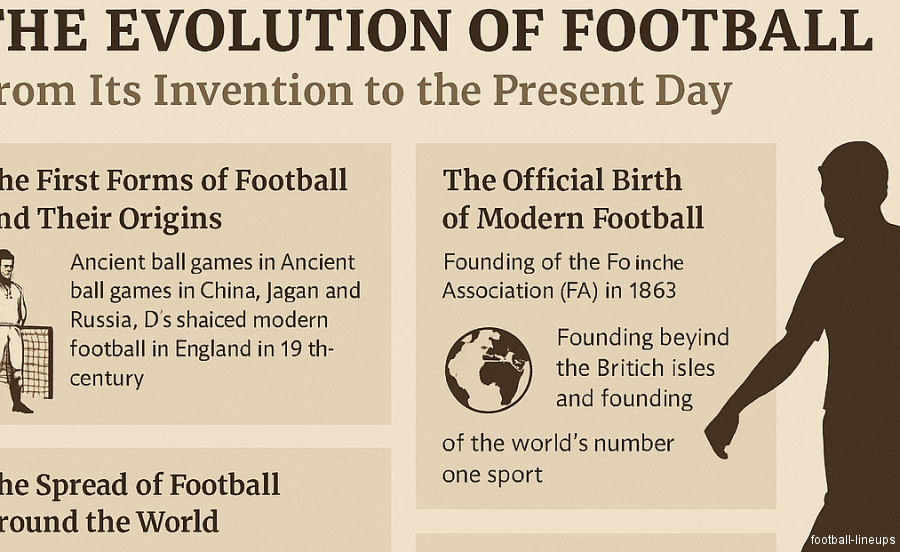
Football, also known as soccer in some countries, is the world’s most popular sport, played by millions of people across every continent. Its history is as fascinating as the game itself, raising questions such as: When and where was football invented? In what year was the first football club created? How did the rules evolve, and why did this sport become so incredibly popular worldwide?
The First Forms of Football and Their Origins
Ancient ball games resembling football existed in China (Cuju), Japan (Kemari), and even in Russia, where villagers played a game called kila. Similar traditions were also recorded in Central America and Greece. However, the foundation of modern football can be traced back to England in the 19th century, where students at colleges and public schools shaped the first formal rules.
The English were influenced by the Italian Renaissance game calcio storico, which allowed dozens of players to participate. Yet, it was the British who transformed the pastime into an organized sport, establishing consistency, rules, and a framework that paved the way for today’s global phenomenon.
The Official Birth of Modern Football
The decisive moment in football history came in 1863, with the founding of the Football Association (FA) in England. This was the first time football was officially recognised as an independent sport.
Key steps taken by the FA included:
- Standardising the size of the field and goals
- Introducing rules to prohibit violent or overly rough play
- Creating the foundation of refereeing
Over time, referees, linesmen, and later assistant referees replaced the disputes once settled by team captains. These steps gave football the structure that closely resembles the game we know today.
The Spread of Football Around the World
By the late 19th century, football’s popularity exploded in England, with more than 100 clubs competing. In 1872, the first official international match between England and Scotland took place, marking the start of football as a cross-border sport.
Soon, football spread beyond the British Isles to Europe, South America, and later the entire world. The founding of the International Federation of Association Football (FIFA) in 1904 unified the rules and gave rise to international tournaments. Neither cultural nor political barriers could stop the growth of the sport, and football quickly became known as the “beautiful game” and the world’s number one sport.
Just as millions enjoy football for its excitement and unpredictability, fans also seek entertainment in other games of chance, such as a scratchcard, which—like football—combines suspense, surprise, and instant rewards.
Evolution of Football Rules Through the Years
When football first took shape, rules varied from one school or region to another. The Football Association’s rulebook gradually established a universal format. Some of the most significant changes include:
- Field dimensions: for the first time, clear boundaries and goal measurements were set.
- Refereeing system: team captains initially argued decisions, but later neutral referees and linesmen were introduced.
- Fair play principles: physical roughness, inspired by early forms of calcio, was reduced.
- Technological innovations: in the 21st century, systems such as VAR (Video Assistant Referee) and goal-line technology revolutionized officiating accuracy.
Each reform made the game faster, fairer, and more engaging for fans.
Professional Football and Leading European Leagues
The professionalisation of football gave rise to legendary clubs and leagues. Today, the most prestigious competitions include:
- English Premier League (EPL) – famous for its global fan base and competitive matches
- La Liga (Spain) – home to giants like Real Madrid and FC Barcelona
- Serie A (Italy) – known for its tactical depth and historic clubs such as AC Milan and Juventus
- Bundesliga (Germany) – celebrated for its stadium atmosphere and youth development
- Ligue 1 (France) – birthplace of world talents and home to Paris Saint-Germain
These leagues set the tone for global football, attracting massive investments, millions of fans, and worldwide media coverage.
Football as a Global Phenomenon
From its humble beginnings in English schools to its dominance as a cultural and sporting force, football has transcended borders. Today, the FIFA World Cup is the most-watched sporting event on the planet, uniting billions of people in celebration.
Modern football is not just about competition. It is a powerful economic driver, a cultural identity marker, and a technological laboratory where new tactics, data analysis, and player performance tracking redefine the sport year after year.
Conclusion
Football is far more than a game—it is a global phenomenon with a rich, centuries-old history. Its journey from ancient ball games to a high-tech spectacle mirrors the evolution of human society itself. With new rules, cutting-edge technologies, and emerging talents, football will continue to evolve, inspire, and unite people for generations to come.